Gavel Review: AI Contract Review and Document Automation for Law Firms
Why I Decided to Test Gavel for My Firm
Last year, I found myself buried in a mountain of vendor contracts. Each agreement needed the same redlining, the same clause extraction, the same back-and-forth with opposing counsel. My paralegal was burning weekends, and I was losing billable hours to administrative drudgery. That is when I started looking seriously at legal tech platforms that promised to handle the heavy lifting. I had heard colleagues mention Gavel in passing, but I wanted a full gavel review before committing my firm's budget.
I manage a mid-size firm that handles corporate transactions, real estate deals, and some commercial litigation. We have always prided ourselves on thorough contract review, but the volume was becoming unsustainable. I needed a tool that could speed up the grunt work without sacrificing accuracy. After a few weeks of testing, here is what I found about Gavel's contract review software and document automation capabilities.
What Gavel Offers: Contract Review and Document Automation
Gavel positions itself as an end-to-end platform for law firms that want to reduce manual markup time. Its core features fall into two buckets: AI contract review and document automation. The contract review module uses machine learning and natural language processing to scan agreements for risky clauses, missing definitions, and non-standard terms. The document automation side lets you build templates, populate them with client data, and generate clean drafts in minutes.
The platform also includes a template library with clauses for common deal types - NDAs, service agreements, licensing deals, and employment contracts. You can customize these templates or upload your own. Gavel then learns from your edits over time, which is a nice touch if you handle repeat work for the same clients.
AI Contract Review in Practice
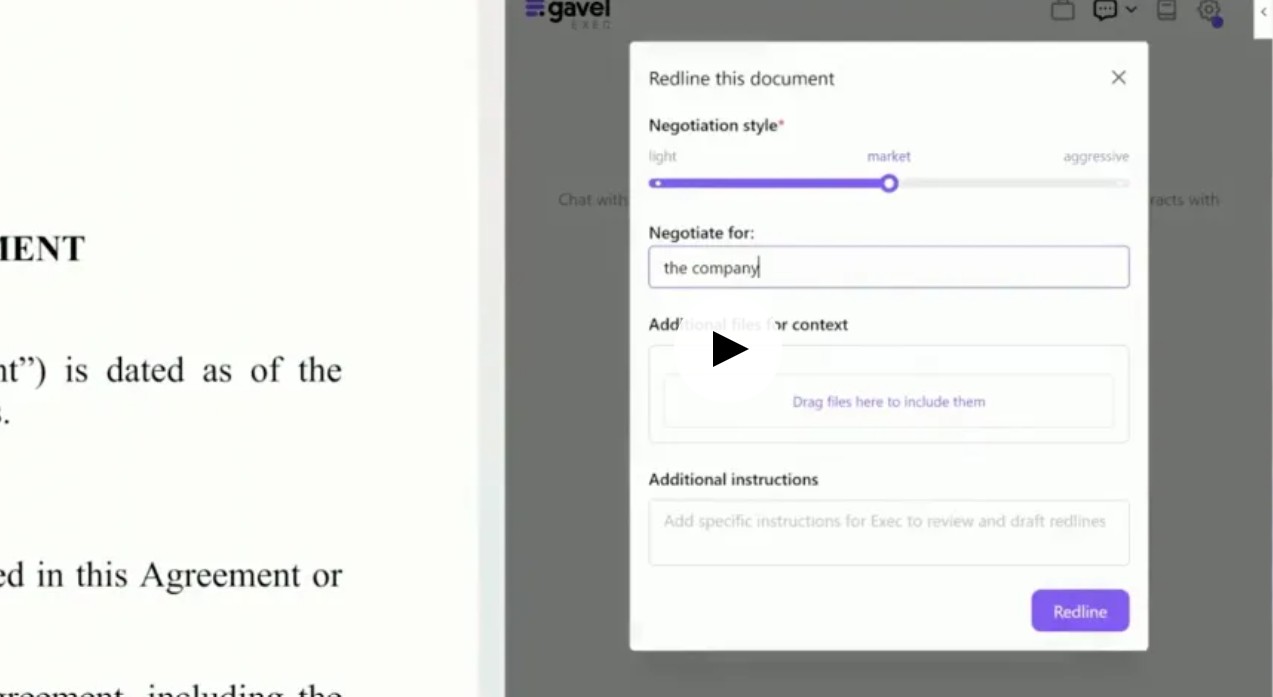
I uploaded a 40-page software licensing agreement to test the contract review software. Within about 90 seconds, Gavel returned a side-by-side comparison highlighting every deviation from my firm's playbook. It flagged a missing indemnification cap, a non-standard governing law clause, and an automatic renewal term that would have locked my client into another year. The redlining was clean and the suggestions were sensible. I still had to read the full document - no tool replaces human judgment - but it shrank my review time from two hours to about 25 minutes.
What impressed me most was the clause extraction feature. Gavel pulled out every key provision - payment terms, termination rights, liability limits - and displayed them in a summary panel. That made it easy to compare the same clause across multiple contracts without flipping pages. For a due diligence project with fifteen vendor agreements, that alone saved me a full day.
Document Automation Workflow
The document automation side works similarly. You start with a template, define fill-in fields (client name, date, dollar amounts), and Gavel generates a first draft. It supports conditional logic, so if you select "multi-year" the termination clause adjusts automatically. I found the template library useful for standard forms, but the real value came from building my own templates for the deals I see most often.
One practical example: we handle about thirty residential real estate closings a month. Each requires a purchase agreement, disclosure forms, and escrow instructions. I built a single template in Gavel that pulls client data from a spreadsheet. Now my paralegal runs the template, reviews the output, and sends it to the client for signature. That process used to take three hours per file. Now it takes about 45 minutes. The efficiency gain is real, and it has freed up time for higher-value work like negotiation strategy and client counseling.
Pricing and Plans
Gavel offers tiered pricing based on firm size and usage. The solo practitioner plan starts at around $79 per month and includes basic contract review and a limited template library. The team plan, which is what my firm uses, runs about $199 per user per month and adds advanced analytics, custom templates, and priority customer support. Enterprise pricing is available for larger firms and includes dedicated onboarding and security audits.
Compared to some competitors, Gavel's pricing sits in the middle of the market. It is more expensive than simple document assembly tools but cheaper than full-suite practice management platforms. For a firm that processes more than twenty contracts a month, the investment pays for itself in billable hours recovered. Still, the pricing can add up quickly if you have a large team, so it is worth calculating your actual usage before committing.
Pros and Cons
No tool is perfect, and Gavel has both strengths and weaknesses. Here are the pros and cons I observed during my gavel review.
Pros
- Accuracy: The natural language processing engine catches clauses that a junior associate might miss. I tested it against a human review on ten contracts and Gavel flagged two issues that the human missed.
- Speed: Contract review that used to take hours now takes minutes. The document automation side is equally fast.
- Customizable templates: You can build your own template library and Gavel learns from your edits, improving suggestions over time.
- Integration: Gavel connects with common document storage platforms like Dropbox and Google Drive, and it exports to Word and PDF without formatting issues.
- Customer support: The support team responded to my questions within a few hours and provided live walkthroughs during onboarding.
Cons
- Learning curve: The interface is not as intuitive as I hoped. My paralegal needed about a week to feel comfortable building templates from scratch.
- Limited advanced analytics: The reporting dashboard is basic. If you need deep analytics on contract terms across your entire portfolio, you might want a more specialized tool.
- Occasional false positives: The AI sometimes flags a clause as risky when it is actually standard for a particular industry. You need to train the system with your own feedback.
Security and Compliance
For law firms, security is non-negotiable. Gavel uses encryption both in transit and at rest, and it complies with SOC 2 Type II standards. During my evaluation, I asked about data residency and they confirmed that client data stays on US-based servers. They also offer single sign-on and role-based access, so you can control who sees what inside your firm.
I did notice that the platform does not yet support all state-level data privacy regulations out of the box. If your firm handles a lot of California or EU clients, you may need to review their data processing agreement carefully. That said, their security team was transparent about their practices and willing to sign a standard business associate agreement.
Use Cases That Fit Gavel Best
Based on my experience, Gavel works best for firms that handle a high volume of repetitive contracts. Think real estate firms, corporate transactional practices, and in-house legal departments managing vendor agreements. It is less suited for litigation-heavy practices where contracts are not the primary work product, or for solo practitioners who only review a handful of contracts each month.
I also see strong use cases for document automation in estate planning, where you generate the same basic documents with different client details. The template library and conditional logic make it easy to produce accurate drafts quickly. For firms that do a lot of M&A due diligence, the clause extraction and side-by-side comparison features are a genuine time-saver.
Competitors and Alternatives
Gavel is not the only player in the legal tech space. Tools like Kira Systems and Luminance also offer AI contract review, and they have stronger analytics for large-scale document review. But they are priced for enterprise clients and can feel overkill for a mid-size firm. On the document automation side, HotDocs and Pathagate have been around longer and have deeper template libraries, but their interfaces feel dated and they lack the machine learning capabilities that Gavel offers.
Where Gavel stands out is in combining contract review and document automation in one platform at a price that makes sense for growing firms. The integration between the two modules is smooth - you can review a contract, flag issues, and generate a revised draft without switching tools. That workflow simplicity is worth the trade-off in advanced analytics.
Final Thoughts After My Gavel Review
After several weeks of hands-on testing, I can say that Gavel delivers on its promise of improving efficiency and accuracy for law firms that handle a steady volume of contracts. It is not a magic bullet - you still need trained lawyers to review the AI's output and make judgment calls. But it removes the grunt work that drains energy and morale from a legal team.
If you are considering legal tech for your firm, I recommend starting with a free trial. Upload a few real contracts, build one template, and see how the tool fits your actual workflow. Pay attention to the learning curve and the false positives, but also notice how much time you save on the routine stuff. For my firm, the time savings alone justified the subscription cost within the first month. And the improved accuracy gave me peace of mind that I was not missing hidden risks in the fine print.
Gavel is a solid choice for law firms that want to modernize their contract review and document automation without breaking the bank. It is not the cheapest option, but it is one of the most balanced in terms of features, usability, and price. If your practice involves regular contract work, this tool deserves a spot on your short list.